Wednesday, April 20, 2022

CCXXXI. SAINT-GEORGES, Chevalier de: Overture to L'Amant Anonyme

CCXXXI. SAINT-GEORGES, Chevalier de (1745-1799)

Overture to L'Amant Anonyme (1780)
Chicago Symphony Orchestra
Riccardo Muti, cond.
(10:03)


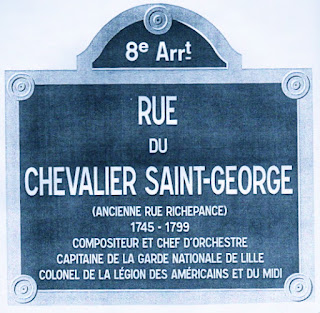
We spoke of the Chevalier back in Post CLXXXI, and his life story is definitely a fascinating read.


**

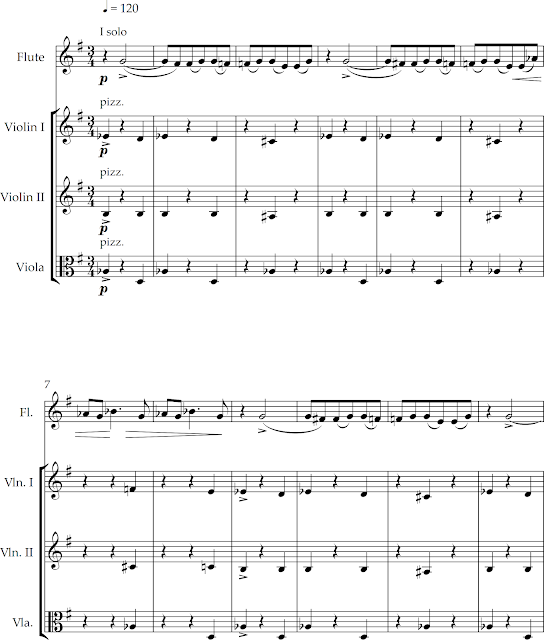
This is the overture to the third of his six operas. It is certainly fine -- intelligent, well-written and with a few bursts of ingenuity -- like this B section in the relative minor (B):


The Andante is lovely, but the final section -- Presto -- is a Haydn-worthy headlong rush into the dance:


Tuesday, April 19, 2022

CCXXX. SHOSTAKOVICH, Dmitri: Symphony #10 in E Minor, Op. 93

CCXXX. SHOSTAKOVICH, Dmitri (1906-1975)

Symphony #10 in E Minor, Op. 93 (1953)
1. Moderato
2. Allegro
3. Allegretto -- Largo -- Più mosso
4. Andante -- Allegro -- L'istesso tempo
Mariinsky Orchestra
Valery Gergiev, cond.
(56:26)


Yes, he's conducting with a toothpick.
Yes, he's good friends with Putin.


The Devil

**

Shostakovich must have felt conflicted on March 5, 1953, the day both Prokofiev and Stalin died.

A dirge for his old friend, Sergei -- and perhaps a gleeful jig at the demise of his  -- and his peoples' -- greatest enemy, the dictator who had made their lives so miserable.

In this symphony -- one of the greatest and mightiest of the Fifteen -- one can clearly hear the voice of Shostakovich. After the deliberate lightness of the 1945 Ninth (see Post CLXX) -- and with the death of his primary censor -- he probably felt the freedom to encode, with little subtlety, his pent-up feelings.

Now, to the music:

First Movement

Perhaps this is the dirge that Stalin thought would be the subject of the Ninth:


The clarinet sneaks in with a mournful, intense line:


Introducing 1/8th-notes and winds/horns, the pitch begins to rise:


An off-kilter waltz for flute and pizzicato strings:


Just the woodwinds given here for this delicious run!


With the initial quarter-note motif in the low winds and brass, Shostakovich brings things to a fantastic pitch:


Themes return, developed, and a lonely piccolo brings the movement to a close:


Second Movement

"I did depict Stalin in my next symphony, right after his death .. it's a musical portrait of Stalin, roughly speaking."

This is spectacular, heart-pounding music. When the snare drum enters (Bar 31 below) the entire atmosphere becomes electric:


and the triumphant ending:


Third Movement

Mixed up in this opening theme are Shostakovich's initials (D-S-C-H) [S = E-Flat; H=B-Natural]. Notice that his initials start with the second note (D), the third note (E-Flat), the first note (C) and the fourth note (B-Natural).


He'll make it clearer in a few moments:


This "name-motif" will be ubiquitous for the remainder of the symphony.

But Shostakovich sneaks another, obscurely hidden, motif -- spelling out the name of his lover (Elmira Nazirova) in a mixture of French and German nomenclature:

E La Mi Re A


The movement dissolves with the horn playing the Elmira motif and the flutes and piccolo chirping out the DSCH motif:


Fourth Movement

Similar to the beginning of the first movement, Shostakovich takes up an Andante theme in B Minor (parallel minor of the dominant) ... a solo oboe plays a mournful tune:


The pace quickens, and the piccolo takes up a dance-like melody:


Building up to a frenzied finale, of course Shostakovich returns to his name-motif, this time blaring out in the horns -- first in 1/4-notes, then in 8th-notes:


and in the final bars, another glorious ascending sweep, ending with a bang ...


Monday, April 18, 2022

CCXXIX. HAYDN, Franz Joseph: Concerto #1 for two Lira Organizzata in C Major

CCXXIX. HAYDN, Franz Joseph (1732-1809)

Concerto #1 for two Lira Organizzata in C Major (1786)
1. Allegro con spirito
2. Andante
3. Finale: Allegro
Matthias Loibner, lire organizzate
Thierry Nouat, lire organizzate
Ensemble Baroque de Limoges
(16:11)


Modern reproductions.

Like a hurdy-gurdy with organ pipes and bellows. Usually, there would be a crank to operate the wheel that activates the strings and bellows to enliven the pipes.

The instrument was a favorite of Ferdinand IV, who commissioned works for it from Gyrowetz, Pleyel, Sterkel, and -- of course -- Haydn.

Sunday, April 17, 2022

CCXXVIII. TISHCHENKO, Boris: Concerto for Violin, Piano and String Orchestra

CCXXVIII. TISHCHENKO, Boris (1939-2010)

Concerto for Violin, Piano and String Orchestra (2006)
1. Fantasia
2. Rondo
3. Interlude --
4. Romance
Mikhail Krutik, violin
Nikolay Mazhara, piano
St. Petersburg Philharmonic Orchestra
Vladimir Altshuler, cond.
(36:13)


Fitting that the orchestra should be St. Petersburg -- the city where Tishchenko spent his entire life.

He studied composition with Galina Ustvolskaya (see Post XXXIII) and later with Shostakovich in the 60's.

FANTASIA

The violinist introduces a descending half-step motif, and the piano issues a few complimentary notes from the bottom of the keyboard (like his teacher, Ustvolskaya, who favored lots of intense action from both extreme ends of the piano). The strings join in canon-type structures -- with that initial descending half-stop motif creating a sonic wall of intense chromaticism.

RONDO

Dance-like and free-wheeling, the movement begins with the pianist again playing in the very lowest register, standing up and muting the string with his other hand. When he does this in the middle register, it sounds like string pizzicato.

Both solo instruments are given stretches where they play together, often in canon. A folk-like melody often makes an appearance.

INTERLUDE-ROMANCE

The Interlude is for the string orchestra alone. The soloists take a break. Very chromatic, featuring small tightly-coiled intervallic clustered writing.

The Romance begins with the soloists duet -- a diatonic 6/8 songlike undulation which switches between major and minor. A nice morendo fades the music away to nothingness.

Saturday, April 16, 2022

CCXXVII. BACH, J.S.: Sonata #3 in C Major for Solo Violin, BWV 1005

CCXXVII. BACH, J.S. (1685-1750)

Sonata #3 in C Major for Solo Violin, BWV 1005 (1720)
1. Adagio
2. Fuga
3. Largo
4. Allegro assai
Shunske Sato, violin
(24:24)


In Sato (the artistic director of the Netherlands Bach Society), you can experience a completely enveloping Bach experience of the highest quality. (see Post CLXXX for his performance of BWV 1003) ...

Adagio

The delicacy and perfect intonation of all these difficult double-, triple-, and quadrupal-stops makes for a deeply-felt interpretation of these first few lines, as Bach modulates to the dominant:


Fuga

Bach's longest fugue for any instrument or combination of instruments.  A monumental 354 bars places incredible demands on the violinist.

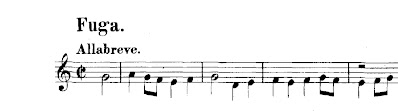
Taken from the chorale, Komm, Heiliger Geist, BWV 652, the subject -- in the relative minor (A), begins:


The entrance -- at the fifth -- introduces the countersubject, a series of descending chromatic half-notes:


The third entrance -- back to the tonic ... look how the subject migrates to the middle voice (second line) with the countersubject now on top!


and after much working out, the subject reappears in a three-voice section using the open D string as the foundation:


al riverso


Bach inverts the subject:


and brings the fugue to a close with an unusual progression, ending with a strong I 6/4 - V - I cadence:


Largo

Moving to the subdominant (F), Bach spins out a multi-voice, delicate melody:


Perpetuum mobile

A continuous flow of 16ths, bringing this massive sonata to a rousing conclusion:


INDEX to 1000 POSTS CLASSICAL BLOG A-M

N-Z ABRAHAMSEN, Hans / 10 Pieces for Orchestra / DCCCXCV ADAMS, John / Century Rolls / XXXVII ADAMS, John / Harmonielehre / CXXI ADAMS, John...