Thursday, February 23, 2023

DXL. SHOSTAKOVICH, Dmitri: Symphony #15 in A Major, Op. 141

DXL. SHOSTAKOVICH, Dmitri (1906-1975)

Symphony #15 in A Major, Op. 141 (1971)
1. Allegretto
2. Adagio -- Largo -- Adagio -- Largo
3. Allegretto
4. Adagio -- Allegretto -- Adagio -- Allegretto
Frankfurt Radio Symphony Orchestra
Andrés Orozco-Estrada, cond.
(48:44)


His final symphony was his first purely instrumental one since the Tenth (1953). He was finally writing something purely joyful -- perhaps -- he whispered to friends, to celebrate his 65th birthday in 1971 ...

First movement

And it begins cheerfully, with a chirping flute, followed by a sardonic bassoon:


And a bit later, this trumpet seems to be hinting at something:


and soon it becomes a Rossini quote, played twice. Hi-ho, Silver!


Shostakovich features the percussion, with tooting trumpet and piccolo:


After some intense development, he swaps the Rossini theme into the winds, and ends the movement with a thump ...



Second movement

A dark F Minor brass chorale, followed by a pleading solo cello:


Is this perhaps death knocking?


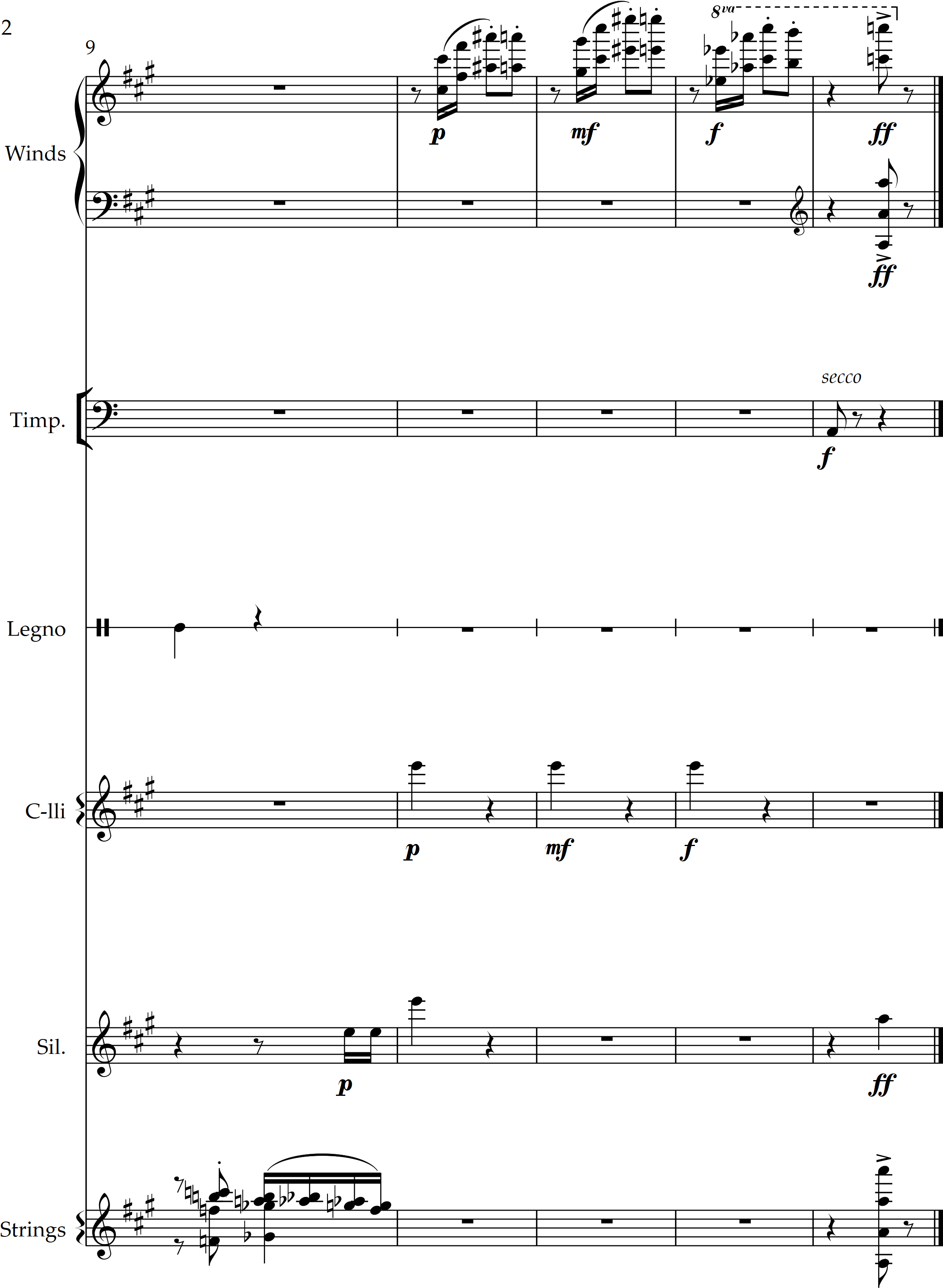
Spooky celesta and vibraphone lead into somber strings; then timpani and bassoons as we attacca into the next movement ...


Third movement

Always ready to lighten the mood after such a heavy movement, Shostakovich jumps into ascending and descending phrases, which might be described as grotesque!


This short section is reminiscent of the end of the Second Movement of the Fourth Symphony (see Post VIII):


and he repeats it to the end the movement, adding a xylophone for additional spookiness:


Fourth movement

The movement begins with somber brass and timpani:


But the mood immediately changes as he launches into a calm Allegretto:


It's worth recalling that the Fourth Symphony -- which was written 35 years before this one -- had only very recently been retrieved from the bottom drawer and performed. This delightful percussion motif ended the previous movement, and here Shostakovich adds the xylophone and a long pp string chord, held for an eternity.

We bid adieu to the great symphonies of Dmitri Shostakovich:


Wednesday, February 22, 2023

DXXXIX. BEETHOVEN, Ludwig van: Sonata #2 in A Major for Piano, Op. 2, No. 2

DXXXIX. BEETHOVEN, Ludwig van (1770-1827)

Sonata #2 in A Major for Piano, Op. 2, No. 2 (1796)
1. Allegro vivace
2. Largo appassionato
3. Scherzo: Allegretto
4. Rondo: Grazioso
Igor Levit, piano
(20:54)


Beethoven's first years in Vienna brought him fame as a superb pianist, but as he finished his studies -- first with Haydn, then Albrechtsberger -- he carefully plotted out the timing of bringing his own mighty compositions to the attention of Vienna musical society.

The three sonatas of Opus 2 (F Minor, A Major, C Major -- hey, a triad!) were extraordinarily new and exciting music. From here onwards, Beethoven's reputation as a composer grew exponentially.

First movement

Such simplicity encapsuled in such beauty. Beethoven tiptoes down the stairs, rises again with a pure tonic scale, and then -- in both voices -- introduces sweeping 16th-note triplets that sounds like a swarm of bees aflight ...


A lovely cadence back to A Major:


 Second movement

A gorgeous Largo with the melody in the bass, sounding like a pizzicato cello!


Third movement

A typical scherzo/trio in A Major and A Minor:


Fourth movement

A brilliant rondo featuring rocketing motifs -- like shooting stars -- which will reoccur throughout the movement:


Beethoven concludes -- not with a bang after all the excitement -- but a quiet peaceful whimper:


Tuesday, February 21, 2023

DXXXVIII. BRITTEN, Benjamin: Our Hunting Fathers, Op. 8

DXXXVIII. BRITTEN, Benjamin (1913-1976)

Our Hunting Fathers, Op. 8 (1936)
1. Prologue
2. Rats Away!
3. Messalina
4. Dance of Death (Hawking for the partridge)
5. Epilogue and Funeral Music
Ian Bostridge, tenor
Britten Sinfonia
Daniel Harding, cond.
(33:08)


Britten seems influenced by Mahler's Das Lied von der Erde (1908-09) [see Post CXXII], not just in flattering echoes, but in the development of inter-movement relationships, which make this work much more than just a song cycle.

The first and final movement are drawn from the poems of W.H. Auden (the second movement is Anon, modernized by Auden; the third movement is Anon., the fourth movement is from Thomas Ravenscroft (c. 1592-1635).

1. Prologue

Britten allows the singer to clearly express the text, with the orchestra providing punches after each line.

2. Rats Away!

Here we hear near-quotes from Das Lied.

The orchestra broadly interacts with the text. One has to wonder what Britten had in mind as a parallel to "rats" in 1936!

3. Messalina

Messalina, a fascinating read which illuminates the text. Beautiful orchestral music ends the movement, with particularly wonderful solos by the winds.

[there are a few moments of silence on this YouTube video before the start of the next movement.]

4. Dance of Death (Hawking for the partridge)

Great intensity between singer and orchestra. The orchestra erupts at the end of the movement.

5. Epilogue and Funeral Music

This incredible poem is layered in between a few bars of an eerie xylophone part, which is further developed after the singer finishes the text.

Monday, February 20, 2023

DXXXVII. ALKAN, Charles-Valentin: Esquisses, Op. 63

DXXXVII. ALKAN, Charles-Valentin (1813-1888)

Esquisses, Op. 63 (1861)
1. La Vision
2. Le Staccatissimo
3. Le Legatissimo
4. Les Cloches
5. Les Initiés
6. Fuguette
7. Le Frisson
8. Pseudo-Naïveté
9. Confidence
10. Increpatio
11. Les Soupirs
12. Barcarollette
13. Ressouvenir
14. Duettino
15. Tutti de Concerto dans le genre ancien
16. Fantasie
17. Petit prélude à trois
18. Liedchen
19. Gr
âces
20. Petit marche villageoise
21. Morituri te salutant
22. Innocenzia
23. L'homme aux sabots
24. Contredanse
25. La poursuite
26. Petit air, Genre ancien
27. Rigaudon
28. Inflexibilité
29. Délire
30. Petit air dolent
31. Début de quatuor
32. Minuetto
33. "Fais dodo"
34. Odi profanum vulgus et arceo, Favete linguis
35. Musique militaire
36. Toccatina
37. Scherzettino
38. "Le ciel vous soit toujours prospére
39. Héraclite et Démocrite
40. "Attendez-moi sous l'arme"
41. Les enharmoniques
42. Petit air à 5 voix
43. Notturino-Innamorato
44. Transports
45. Les diablotins
46. Le premiere billet doux
47. Scherzetto
48. En songe
49. Laus Deo
Laurent Martin, piano
(1:14:45)
[scrolling score]


Like all of Alkan's works, [see the Symphony, Op. 39 (see Post LXIX)], these gorgeous "sketches" can be performed by only the most virtuosic of pianists.  Only a few have recorded the complete work, and Martin is -- thankfully -- one of them.

This extraordinary music confirms the feeling that Alkan was way ahead of his time!

Sunday, February 19, 2023

DXXXVI. HAYDN, Franz Joseph: String Quartet #12 in C Major, Op. 9, No. 1

DXXXVI. HAYDN, Franz Joseph (1732-1809)

String Quartet #12 in C Major, Op. 9, No. 1 (1769)
1. Adagio
2. Menuet
3. Scherzo. Presto
4. Menuet
5. Finale. Presto
Aeolian String Quartet
(23:27)
[scrolling score]


Written just three years after his elevation to the full rank of Kapellmeister in the employ of the Esterházy family, these early quartets show his making the form his own. The two minuets perhaps underscore the importance of the dance, even in this medium where the audience was probably seated.


Esterháza

INDEX to 1000 POSTS CLASSICAL BLOG A-M

N-Z ABRAHAMSEN, Hans / 10 Pieces for Orchestra / DCCCXCV ADAMS, John / Century Rolls / XXXVII ADAMS, John / Harmonielehre / CXXI ADAMS, John...