Monday, February 7, 2022

CLIX. MYASKOVSKY, Nikolai: Symphony #19 in E-Flat Major, Op. 46

CLIX. MYASKOVSKY, Nikolai (1881-1950)

Symphony #19 in E-Flat Major, Op. 46 (1939)
1. Maestoso (5:27)
2. Moderato (6:26)
3. Andante serioso (7:05)
4. Poco maestoso (4:37)
State Academic Orchestra
Evgeny Svetlanov, cond.


[I usually prefer to choose a live YouTube performance, but in this case the Tokyo Wind Sinfonica was not up to the standards of this wonderful Soviet performance.]

**

Here's something to chew on:

In 1935, CBS radio asked its audience to name the Top Ten contemporary composers who would "remain among the world's greats" in 100 years?

The winners? Prokofiev, Rachmaninoff, Shostakovich, Richard Strauss, Stravinsky, Sibelius, Ravel, de Falla, Fritz Kreisler, and ... Myaskovsky!

Often called the "Father of the Soviet Symphony," Myaskovsky wrote 27 of 'em.

This one was written for the Red Army band -- but its musical materials are just as profound and exciting as his works which include a string section.

There are no saxophones -- probably because they were considered a decadent instrument of the West.

First Movement

A broad Maestoso quickly leads into this delightful little skipping melody in the Cornet:


A secondary -- slightly related -- theme in the Tenor and Baritone Horns is accompanied by contrapuntal writing in the clarinets ...


The two themes are developed and brought to a rousing conclusion.

Second Movement

A slow, eerie waltz-like movement begins with a tender melody in the clarinet:


Later, Myaskovsky inserts a strange duple-meter with which he continually interposes the original 3/4:


Third Movement

A slow dirge with tubas and baritone horn:


Fourth Movement

After a brief maestoso, Myaskovsky really lets thing fly with this romping 6/8, and then brings the whole symphony to a crashing conclusion, with a restatement of the initial, first movement maestoso ...


Sunday, February 6, 2022

CLVIII. MOZART, Wolfgang Amadeus: Sinfonia from Die Schuldigkeit des ersten Gebots, K. 35

CLVIII. MOZART, Wolfgang Amadeus (1756-1791)

Sinfonia from Die Schuldigkeit des ersten Gebots, K. 35 (1767)
Radio-Sinfonieorchester Stuttgart
Neville Marriner, cond.
(scrolling score)
(3:49)


When Mozart died at the age of 35, the world was left with a treasure trove of indescribably beautiful music of all sorts -- mostly from the last 10 or 15 years of his life.

But as most people know, he was at it from a very early age.

**

This is Mozart's first opera -- or geistliches singspiel (sacred musical play) -- and was written at the age of 11.

At 2:23 he manages a nice modulation to the relative minor.

Saturday, February 5, 2022

CLVII. MESSIAEN, Olivier: Des canyons aux étoiles (From the Canyons to the Stars)

CLVII. MESSIAEN, Oliver (1908-1992)

Des canyons aux étoiles (From the Canyons to the Stars) (1974)
Part 1:
1. Le Désert (The desert)
2. Les orioles (The orioles)
3. Ce qui est écrit sur les étoiles (What is written in the stars)
4. Le Cossyphe d'Hueglin (The white-browed robin-chat)
5. Cedar Breaks et le don de crainte (Cedar Breaks and the gift of awe)
Part 2:
6. Appel interstellaire (Interstellar call)
7. Bryce Canyon et les rochers rouge-orange (Bryce Canyon and the red-orange rocks)
Part 3:
8. Les Ressuscités et le chant de l'étoile Aldebaran (The resurrected and the song of the star Aldebaran)
9. Le Moqueur polyglotte (The mockingbird)
10. La Grive des bois (The wood thrush)
11. Omao, leiothrix, elepaio, shama
12. Zion Park et la cité céleste (Zion Park and the celestial city)
ANAM Orchestra
Jacob Abela, piano
Kaylie Melville, xylorimba
Peter Neville, glockenspiel
Ben Jacks, French Horn
Fabian Russell, cond.
(1:37:01)


The three most important aspects of Messiaen's music are:
  1. His theory of modes of limited transposition; and
  2. His synaeshtesia.
  3. His use of bird-song.
(Well-explained in these Wikipedia articles.)

**

Canyons was commissioned by Alice Tully for the 1976 bicentennial. The work is in three parts, written with 12 symmetrically-spaced movements (5/2/5) ...

Part 1

1. The Desert
.


He who is to be found is vast: one must discard everything in order to take the first steps towards him."

A slow chant in the solo French Horn begins and ends the movement, with the wind machine, cries from a Sahara bird, with a whistling melody that passes from bowed crotales to piccolo to violin harmoncs.


2. The Orioles.


3. What is written in the stars ...

MENE TEKEL UPHARSIN (from Daniel 5 -- reading the writing on the wall) ...

The message is written in the stars and the clefts of the canyons. The rock-music is followed by the sound of the earth which is represented by a percussion instrument of Messiaen's own invention -- the geophone -- then the sound of the Canyon Wren:


The music is palindromic, and reverses.

4. The White-Browed Robin.


Moving from Utah to the universe, an African bird is introduced. Repeated phrases become bird-song, and again, the movement is roughly palindromic.

5. Cedar Breaks and the Gift of Awe.


"a vast amphitheatre, dropping to a deep gorge, whose rocks -- orange, yellow, brown, red -- rise in curtain walls, columns, towers, turrets and keeps."

Weird sounds -- the trumpet blows into the mouthpiece alone, plays with a wa-wa mute doubled by the glockenspiel and bells. Awe is the American Robin:


Part 2

6. Interstellar Call
.

Written earlier (1971) as a memorial to his young pupil Jean-Pierre Guézec.

7. Bryce Canyon and the Red-Orange Rocks.


"a gigantic circle of rocks -- red, orange, violet -- in fantastic shapes, castles, square towers, round towers, natural windows, bridges, statues, columns, whole cities, with here and there a deep black hole."

Blue-and-black Steller's Jay:


(brass and percussion near the start)

The landscape suggests the Celestial City = chorales, bells, allelulas; much repetition

Black holes = tam-tam, low trombones

Dance in octaves; E Major ending ...

Part 3

8. The Resurrected and the Song of the Star Aldebaran.

The song of Aldebaran in the strings ... harmonic effects ("add their drops of water, their rustlings of silks").

The resurrected = piccolo, glockenspiel and the highest notes of the piano ...

9. The Mockingbird.


Piano solo.

10. The Wood Thrush.


A C Major arpeggio ("the new name promised for each soul" [Revelation 2:17]) = stopped horn and alto flute. The horn repeats G-E-C; the new name is bestowed and accepted.

11. Omao, Leiothrix, Elepaio, Shama.

Hawaiian birds:

Omao


Leiothrix


Elepaio


Shama


12. Zion Park and the Celestial City.

"a vision of Paradise in the pink, white, mauve, red and black walls, the green trees and the clear water of Zion Park."

Chorale of joy and arrival is interrupted by birdsong choruses until the final A Major (blue, for Messiaen), with horn whoops and chimes, glowing to a tutti fortissimo.


Friday, February 4, 2022

CLVI. PROKOFIEV, Sergei: Symphony #4 (First Version), Op. 47

CLVI. PROKOFIEV, Sergei (1891-1953)

Symphony #4 (First Version), Op. 47 (1929)
1. Andante assai
2. Andante tranquillo
3. Moderato, quasi Allegretto
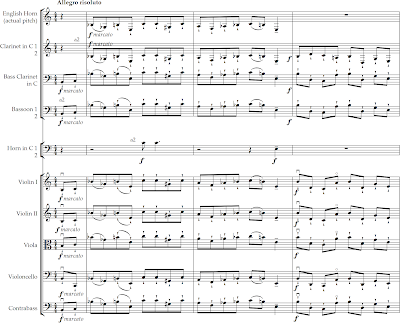
4. Allegro risoluto
Scottish National Orchestra
Neeme Järvi, cond.
(23:09)

This is the first version. Prokofiev completely rewrote the symphony in 1947, giving it a new opus number -- 112. The second version -- written after the Zhdanov crackdown (composers were expected to write more realistic "Soviet-style" music) -- is quite different than this version, more akin to the well-received Fifth Symphony (Post XLVIII) ...

Both versions "borrow" music from his ballet, The Prodigal Son. As he was composing the ballet for Diaghilev, he thought the music would also be good as a purely instrumental symphony -- so he wrote this first version, borrowing heavily from the ballet music -- some of which Diaghilev had rejected ...

The ballet was successful, but Diaghilev died the following year and it was not produced again until many years later.

Meanwhile, Prokofiev had been discussing a commission with Serge Koussevitsky for the Boston Symphony's 50th annivesary. Disagreements over the financial considerations made a mess of the whole situation, and Prokofiev did not attend the premiere.

**

Prokofiev retained a fondness for this first version, saying:

"I love it, for its absence of noisy effects and for its great abundance of material."

**

First Movement

A calm introduction in the woodwinds:


followed by a typically vigorous main theme:


A lyrical secondary theme arises in the winds again:


Development; recap; and a big C Major chord to end the movement.

Second Movement

Calm, C Major:


The movement glides through a number of differentiated sections, closing finally with an echo of the begining tranquillity:


Third Movement

A scherzo & trio -- a delicate dance to be sure, but look at the simplicity of the orchestration:


Fourth Movement

A rip-roaring unison starts the movement off:


There's a constant struggle between key centers; finally moving between C Minor and Major with a firm C Major chord ending the work.


Thursday, February 3, 2022

CLV. LIGETI, György: Atmosphères / Lux Aeterna

 CLV. LIGETI, György (1923-2006)

Atmosphères (1961)
Orquesta Filarmónica de Berlin
Simon Rattle, cond.
(8:56)

Lux Aeterna (1966)
Ensemble Aedes
Mathieu Romano, cond.
(8:57)


It is the power of film, when combining daring imagery and even more daring music, to produce a strong psychological effect in the viewer/listener.

Many of you may experience a visual image of the film -- or even more micro -- a remembrance of watching the film; who you were with, where you were, etc.

These live performances, however, capture the true genius of Ligeti's music, and one can better fully appreciate the way the music was composed.

The main musical effect is that of tone clusters.

The opening bars of Atmosphères, for example, contain a chromatic cluster spanning five octaves held by the strings and winds.

Gradually, instruments drop out from the cluster, and reemerge in different forms. The music has been described as a "dense sound-fog."

**

Lux Aeterna is, of course, from the Latin mass.

Lux aeterna luceat eis, Domine, cum sanctis tuis in aeternum, quia pius es. Requiem aeternam dona eis, Domine; et lux perpetua luceat eis ...

May everlasting light shine upon them, O Lord, with thy saints in eternity, for thou art merciful. Grant them eternal rest, O Lord, and may everlasting light shine upon them.

**

Ligeti uses the same cluster technique here, in addition to spreading a rhythmic device amongst the 16 voices:

Each voice uses a different rhythmic value [16th-notes (4); quintuplets (5) and sextuplets (6)], which has the effect of erasing any pedestrian beat -- leaving the music with a floating feeling that is unbound from any pulse.

**

Someone made a video of Atmosphères with images from the film.

Tuesday, February 1, 2022

CLIII. MOZART, Wolfgang Amadeus: Symphony #16 in C Major, K. 128

CLIII. MOZART, Wolfgang Amadeus (1756-1791)

Symphony #16 in C Major, K. 128 (1772)
1. Allegro maestoso
2. Andante grazioso
3. Allegro
Downtown Sinfonietta
Vincent Lionti, cond.
(12:12)

First of all, this small ensemble is perfect for Early Mozart. He was 16 when he composed this -- and, looking carefully, one can discern all the wonderful things in his music which would blossom as he aged.

It's hard to imagine that at this point, he had already lived about half of his lifetime.

**

The symphonic form at this point resembled what is called the Italian overture -- three movements: fast/slow/fast.

Notice how Mozart -- using 8th-note triplets -- gives the initial music the feeling of a lilting 9/8 rhythm (arrow) ...


but he soon removes the triplets to reveal the true time signature, 3/4 (arrow):


The slow movement -- for strings alone -- is strikingly delicate and lovely. Notice the change of mood with the introduction of stacatto (eyeglasses) and then the quick figures trading off in the violins (green eyeball) ...

The third movement is a typical rondo, with a shift to the relative A Minor in the middle.


INDEX to 1000 POSTS CLASSICAL BLOG A-M

N-Z ABRAHAMSEN, Hans / 10 Pieces for Orchestra / DCCCXCV ADAMS, John / Century Rolls / XXXVII ADAMS, John / Harmonielehre / CXXI ADAMS, John...