Monday, August 29, 2022

CCCLXII. MOZART, Wolfgang Amadeus: Piano Quartet #1 in G Minor, K. 478

CCCLXII. MOZART, Wolfgang Amadeus (1756-1791)

Piano Quartet #1 in G Minor, K. 478 (1785)
1. Allegro
2. Andante
3. Rondo (Allegro)
Alina Pogostkina, violin
Veronika Hagen, viola
Mischa Meyer, cello
Jérôme Ducros, piano
(25:41)


Keep in mind that a composer's relationship to any particular publisher depends on an understanding that the work would sell to amateur musicians, who -- depending on their abilities -- wanted something fresh and new to play after the servants had cleared the table ...

Franz Anton Hoffmeister -- two years Mozart's senior -- studied law in Vienna; then decided to become a composer; then set up his own publishing house the year of this composition.

He commissioned three piano quartets -- the first work ever written for such a combination of instruments, it is believed -- and was nonplussed when he realized what difficulties the work would impose upon the average amateur.

An article in a music magazine a few laters later confirmed his feelings:

"As performed by amateurs, the work could not please: everybody yawned with boredom over the incomprehensible tintamarre of four instruments which did not keep together for four bars on end, and whose senseless concentus never allowed any unity of feeling; but it had to please, it had to be praised! What a difference when this much-advertised work of art is performed with the highest degree of accuracy by four skilled musicians who have studied it carefully."

Hoffmeister allowed Mozart to keep the advance and released him any further obligation. Busy at work on Figaro [see Post CCLXXXVI], he immediately returned to the form after the opera's completion with another -- the E-Flat Major, K. 493.

**

First Movement

In a perfectly symmetrical eight-bar phrase, Mozart posits the serious G Minor theme -- two bars of unison, and a two-bar "response" in the piano, which ends on the dominant in Bar 4 and the tonic in Bar 8:


The development shifts to the subdominant (C Minor):


This bar is particularly lovely with its confluence of 1/8th-notes:


Second Movement

Relative Major (B-Flat) moving to F Major. A really beautiful slow movement, with Mozart giving carefully corresponding parts in all four instruments:


Thrid Movement

In the parallel major (G) ...

Mozart orchestrates this happy rondo with a specific pattern:

Starting with eight bars of solo piano, eight bars of tutti, eight bars of piano, and eight bars of strings only:


Later it's just a two-bar call-and-response:


and then one-bar:


and before he wraps things up, he shocks us with this deceptive cadence:


Sunday, August 28, 2022

CCCLXI. MYASKOVSKY, Nikolai: Symphony #24 in F Minor, Op. 63

CCCLXI. MYASKOVSKY, Nikolai (1881-1950)

Symphony #24 in F Minor, Op. 63 (1943)
1. Allegro deciso
2. Molto sostenuto
3. Allegro appassionato
State Academic Symphony Orchestra
Vladimir Jurowsky, cond.
(36:27)


It is a shame that Myaskovsky's 27 symphonies are so infrequently performed. I've previously made posts on #2 (CXVI) and #19 (CLIX).

**

This one -- written during the war -- is astonishingly coherent, with typically nuanced "Russian" orchestration. The intensity never subsides, but the music breathes naturally and effortlessly:

First Movement

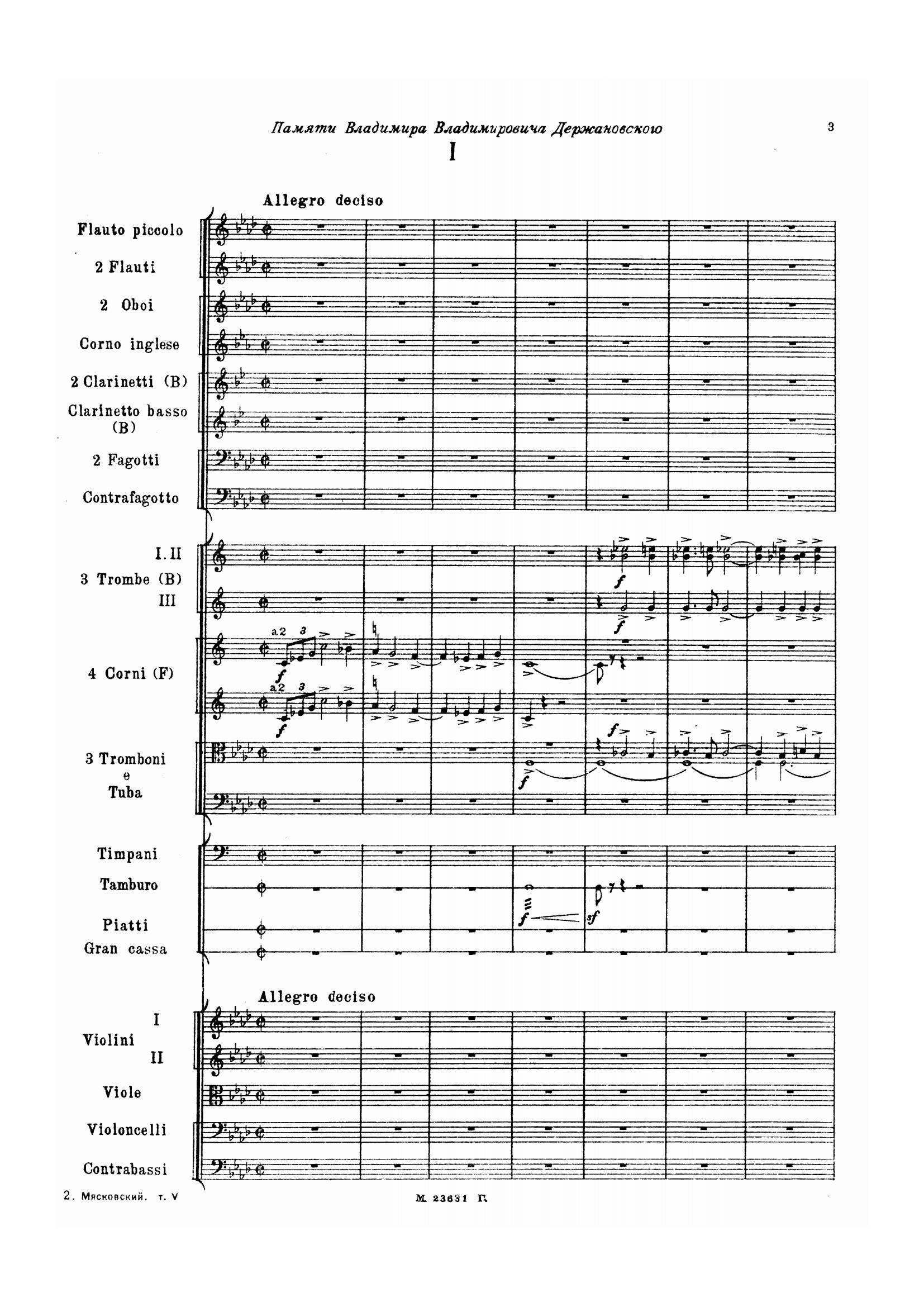
After a brass fanfare, the theme is stated by bassoons and celli, accompanied by repeated low F's in the basses and timpani:


The theme is taken up and reworked by different combinations -- here with 1/4-note triplets accompaniment:


and combines it with the 8th-note triplet reference from the opening fanfare:


Here the flutes play the theme in sixths, with a solo trumpet providing counterpoint:


A beautiful horn solo, followed by clarinet:


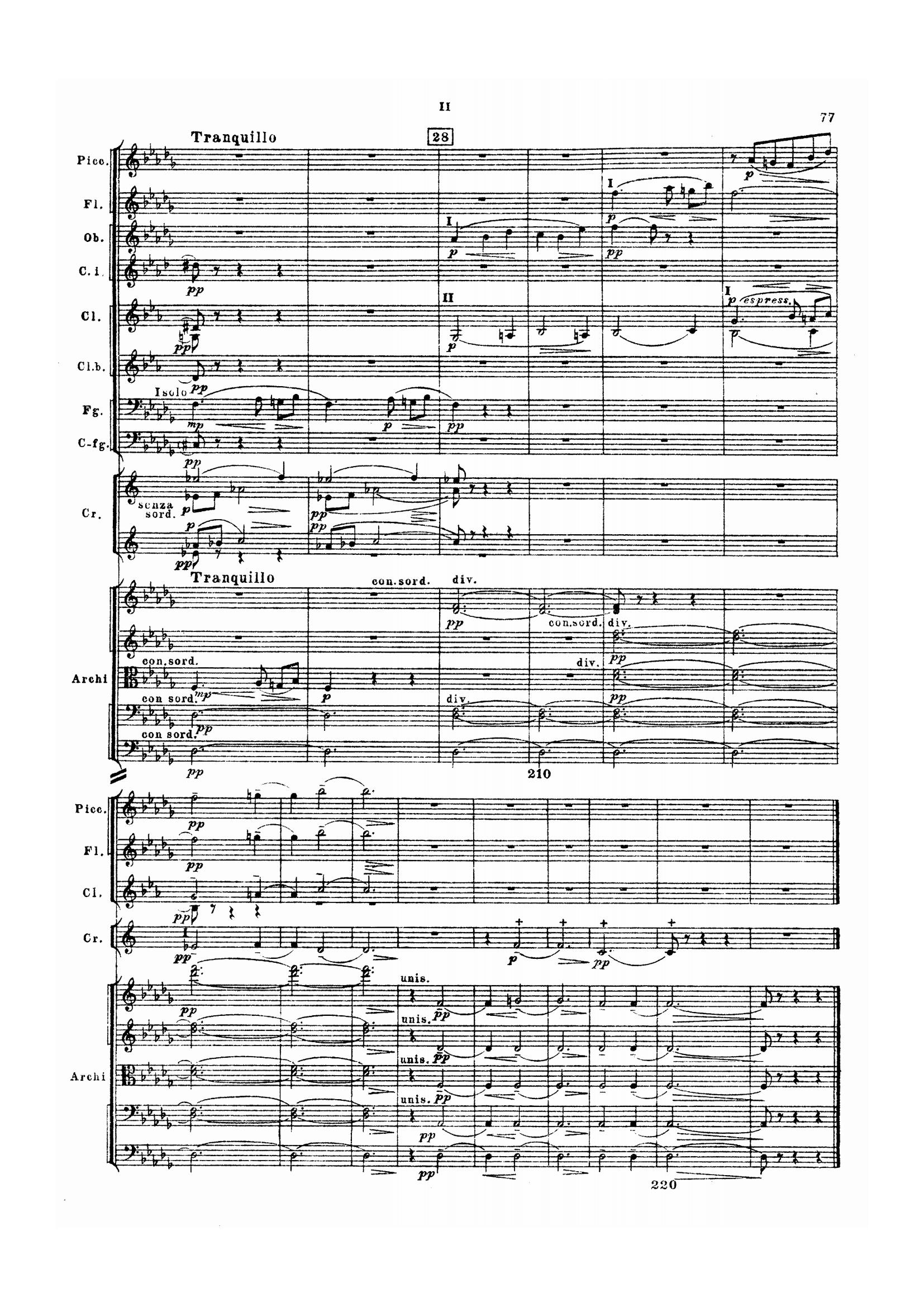
The bassoons restate theme and the movements ends with in a fading F Minor chord in the strings:


Second Movement

Beginning with a lonely clarinet, the texture gradually thickens. The marking molto sostenuto could not be more appropriate -- the entire movement is sustained and melancholy ...


An entirely new section features these sharp 16th-note triplets:


The main theme of the first movement keeps popping up ... in fact, it is omnipresent throughout the entire symphony:


Myaskovsky changes keys frequently -- the harmonic language is always moving towards surprises!

Here, the marking molto patetico indicates the degree to which he wants to emphasize the tragic nature of the music -- written of course during one of the worst periods of the war.


Another key change to end the movement -- to D-flat Major, the submediant.


Third Movement

Myaskovsky was expected to follow his father's footsteps into the military ... and in fact, he did become an engineer, and served in the Red Army. But he had heard Tchaikovsky's Sixth Symphony in his teens, and never really gave up his ambition to be a musician.

The influence of military music is evident here, right off the bat:


A further reworking of the main theme is now accompanied by rugged 16th-notes:


Another lovely horn solo is now accompanied by the 16th-note figures:


Three trombones and tuba. You can't beat that sound!


One of many key changes -- here to B Minor -- about as far away from F Minor as one can get!!


The trumpet gets a solo over the 16th-note figures:


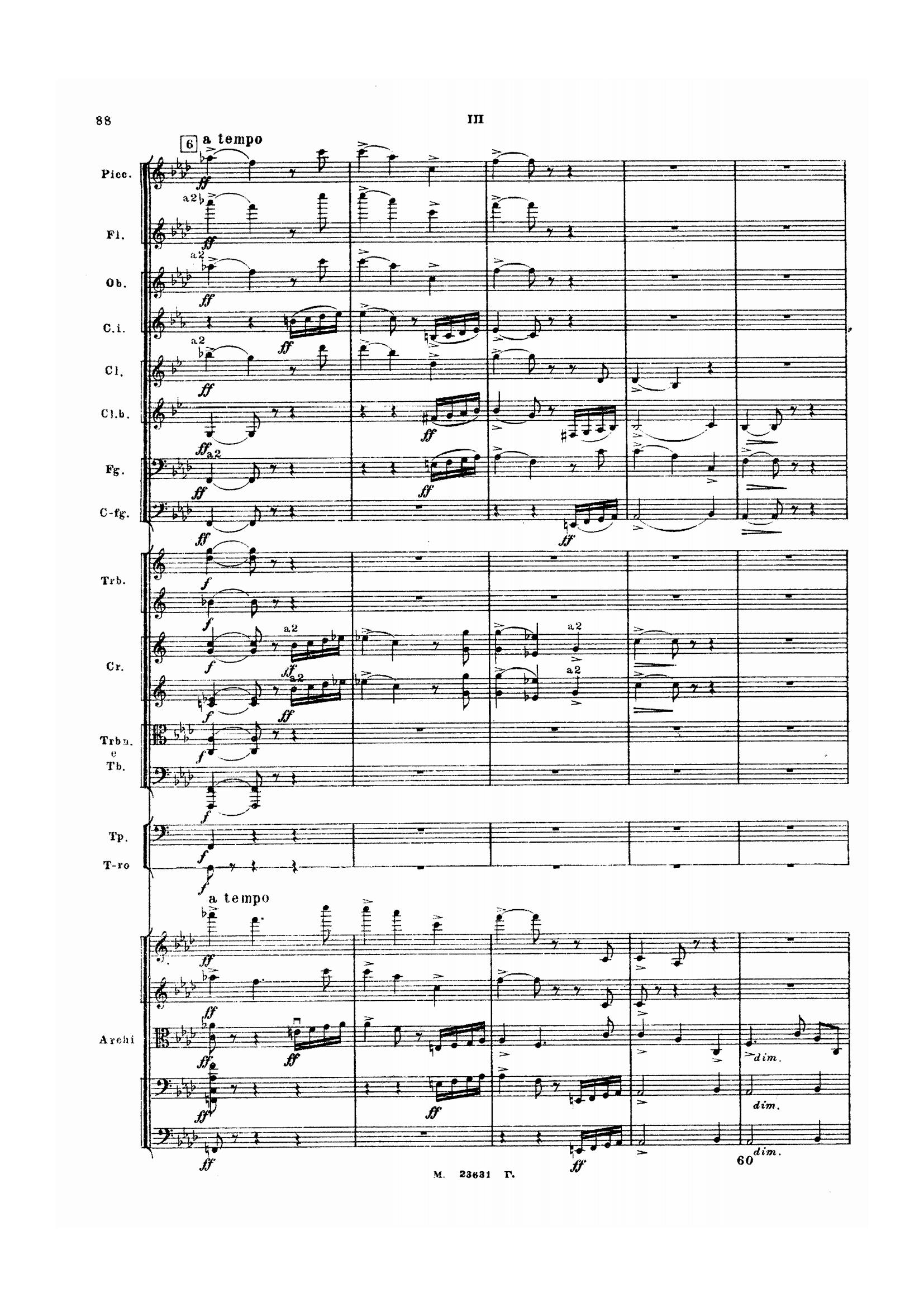
A huge D-Flat diminished chord in third inversion:


The symphony concludes with a descending passage to a soft F Major chord ... perhaps there is hope ...


a note on the brilliance of the Russian school of orchestration:

Notice the placement of the third (A) in the piccolo (sounds an octave lower) and the English Horn with the clarinets and flutes filling in the other intervals:


Saturday, August 27, 2022

CCCLX. PARTCH, Harry: Ring Around the Moon -- A Dance Fantasm for Here and Now

CCCLX. PARTCH, Harry (1901-1974)

Ring Around the Moon -- A Dance Fantasm for Here and Now (1949)
Phase One -- Well, bless my soul! (Well, bless my soul!) (2:48)
Phase Two -- One, two, three, four -- X, Y, Zee (2:12)
Phase Three -- Shake hands now, boys, and at the sound of the bell come out fighting! (2:55)
Phase Four -- Mumbo jumbo, hocus pocus, hoity toity, hotsy totsy, acey ducey, hoochy koochy (Look out! He's got a gun!) (1:31)
Gate 5 Ensemble
Horace Schwartz, cond.


Ring is the second section of a larger work, entitled Plectra and Percussion Dances. Ring itself is a reworking of the Sonata Dementia (see Post XCI).

The instruments:

Adapted Guitar II


Kithara

Harmonic Canon


Chromeloden I


Cloud-Chamber Bowls


Marimba Eroica


Diamond Marimba


Bass Marimba


Friday, August 26, 2022

CCCLIX. BEETHOVEN, Ludwig van: Hol' euch der Teufel! B'hüt euch Gott!, WoO 173

CCCLIX. BEETHOVEN, Ludwig van (1770-1827)

Hol' euch der Teufel! B'hüt' euch Gott!, WoO 173 (1819)
Kammerchor der Berliner Singakademie
(0:15)


Devil take you! God protect you!

Beethoven was fond of canons. The theme of the Late Quartet in F, Op. 135 is based on one (see Post CCLXVI) ...

Beethoven was not fond of most of his publishers. Sigmund Anton Steiner was the recipient of this slightly nasty one.

In any case, Beethoven wrote out the first voice and challenged anyone to properly place the second.


It seems that Czerny provided the elusive answer to the puzzle! The second voice enters on the second. (Most canons answer on the fourth or fifth.)


Thursday, August 25, 2022

CCCLVIII. MOZART, Wolfgang Amadeus: Idomeno, K. 366

CCCLVIII. MOZART, Wolfgang Amadeus (1756-1791)

Idomeneo, K. 366 (1781)
Steve Davislim, Idomeneo
Monica Bacelli, Idamante
Camilla Tilling, Ilia
Emma Bell, Elettra
Francesco Meli, Arbace
Robin Leggate, High Priest of Neptune
Ernesto Panariello, The Voice
Silvia Mapelli, First Cretan Woman
Marzia Castellini, Second Cretan Woman
Massimiliano Italiani, First Trojan Man
Giuseppe Cattaneo, Second Trojan Man
Orchestra and Chorus of Teatro Alla Scala
Daniel Harding, cond.
(2:37:56)


The Plot in a Cartoon (5:36)

Wikipedia


**

It struck me while studying this great opera, that Mozart's libretto, with its ridiculous plot is similar to today's superhero films with huge budgets that are all based on a comic book story from the 50's.

Adapted by Giambattista Varesco from a French text by Antoine Danchet, based on a 1705 play by Crébillion père, which had been set to music by André Campra in 1712.

As silly as the story is, Mozart's music turns it all into a grand feast for the eyes and ears ...

Overture

With a grand start outlining a D Major triad, notice how Mozart quickly digresses into foreboding chromaticism:


Modulation to A Major:


ARIAS

Act One

1. ILIA: Padre, germani, addio (Father, brothers, farewell)


Father, brothers, farewell!
You are no more; I have lost you.
Greece, you are the cause;
And shall I now love a Greek?

I know that I am guilty
Of abandoning my kin;
But I cannot bring myself,
O gods, to hate that face.

2. IDAMANTE: Non ho colpa (I am not guilty)


Note that Idamante -- a young man -- is played by a woman. As the castration of young boys became passé, the roles were often taken up by tenors (Mozart used one in the Vienna production of this opera) ... the use of females to play these parts is a fairly recent innovation. See here.

The fault is not mine, and you condemn me,
My love, because I adore you.
The fault is yours, tyrannical gods,
And I die of distress and pain
For a crime which is not mine.

If you so desire it, at your command
I will pierce this breast of mine;
I read it in your eyes, it's true,
But at least tell me with your lips,
And I will ask no other mercy.

3. ELETTRA: Tutte nel cor vi sento furie del cupo averna (I can feel you all in my heart, furies of the dark hell)

Matching the text, the music is full of fury and torment:


In my heart I feel you all,
Furies of bitter Hades;
Far from such fierce torment
Be love, pity, or mercy.

Let her who stole that heart
Which betrayed mine
Feel my fury
And cruel revenge.

4. IDOMENEO: Vedrommi intorno (I shall see around me)


I shall see about me
A lamenting shade
Which night and day
Will cry to me "I am innocent."

The blood spilt
From his pierced breast,
His pale corpse
Will point out to me
My crime.

What horror,
What grief!
How many times
This heart
Will die
Of torment!

5. IDAMANTE: Il padre adorato (My beloved father)


My beloved father
I find again, only to lose him.
He scorns and flies me,
Trembling with horror.

I thought I would die
Of joy and love,
But, cruel gods,
Grief is killing me.

Act Two

6. ILIA: Se il padre perdei (If I lost my father)

(With woodwinds and horn providing a light touch of accompaniment.)


If I have lost my father,
My country and my peace of mine,
You are now a father to me,
And Crete is for me
A blessed land to stay.

Now I recall no more
My anguish and distress;
Now heaven has given me
Joy and contentment
To compensate for my loss.

7. IDOMENEO: Fuor del mar (Out of the sea)

Idomeneo regrets the devilish deal he made with Neptune ...


Saved from the sea, I have a raging sea
More fearsome than before within my bosom,
And Neptune does not cease
His threats even in this.

Stern god! Tell me at least,
If my body was so close to shipwreck,
For what cruel purpose
Was that wreck withheld?

8. ELETTRA: Idol mio (My sweetheart)


My dearest, if reluctantly
Your other lover yields you to me,
Constrained love does not deter me,
And your coldness is more alluring to me.

Passion close at hand will drive
From your heart more distant fires;
The hand of love has more power
When the beloved is near.

Act Three

9. ILIA: Zeffiretti lusinghieri (Zephyrs caressing)


Gently caressing zephyrs,
Oh fly to my beloved
And tell him I adore him
And to keep his heart true to me.

And you plants and tender flowers
Which my bitter tears water
Tell him that you never saw
A love more rare beneath the sky.

10. Quartet: ILIA/IDAMANTE/IDOMENEO/ELETTRA: Andro ramingo e solo (I will go on my wanderings alone)

Mozart quartets like this are not be missed!


IDAMANTE:

I will go on my wanderings alone,
Seeking death elsewhere
Until I find it.

ILIA:

You will have me as a companion in your grief
Wherever you go.
And where you die I too will die.

IDAMANTE:

Ah, no!

IDOMENEO:

Pitiless Neptune!
Who, in mercy, will take my life?

ELETTRA:

When shall I be revenged?

IDAMANTE, ILIA:

Calm your angry brow!

IDOMENEO, IDAMANTE, ILIA:

Ah, my heart is breaking.

ALL:

To suffer more is impossible.
Such great grief
Is worse than death.
No one ever suffered
A harsher fate
Or greater punishment.

11. THE VOICE: Ha vinto amore (Love has triumphed)

The trombone players have been sitting around for hours without playing a single note. Suddenly, they are required to play long tones to accompany Neptune's voice:


Love has triumphed ... Idomeneo
Shall cease to reign; Idamante shall be king, and Ilia
His bride ... Then will Neptune be appeased,
Heaven contended and innocence rewarded.

12. ELETTRA: D'Oreste, d'Ajace ho in seno i tormenti (I feel Orestes's and Ajax's torments in my heart)


Within my breast I feel
The torments of Orestes and Ajax;
Alecto's torch
Brings me death.

Tear out my heart,
You horned serpents
Or a sword
Shall end my pain.

13. IDOMENEO: Torna la pace (Peace comes again)


Peace returns to my heart
And extinguished ardour is rekindled;
Youth is reborn in me.

Thus does Flora's season
Make the old tree bloom again
And give it fresh vigour.

INDEX to 1000 POSTS CLASSICAL BLOG A-M

N-Z ABRAHAMSEN, Hans / 10 Pieces for Orchestra / DCCCXCV ADAMS, John / Century Rolls / XXXVII ADAMS, John / Harmonielehre / CXXI ADAMS, John...